The family of Donald Thomson donates one of the largest collections of Aboriginal cultural heritage to the University of Melbourne

The UNESCO-inscribed Donald Thomson Ethnohistory Collection, which provides rare insights into the rich cultural and economic lives of Indigenous peoples of Australia, has been gifted to the University of Melbourne by his family. The gift has been made in the memory of its collector Professor Donald Thomson OBE (1901-1970), who dedicated his life to championing equality for Indigenous Australians, and his wife, Mrs Dorita Thomson (1930-2022).
Considered one of the most detailed and finest collections of its kind, the landmark donation unifies the two parts of Professor Donald Thomson’s extensive field work under the University’s care after the Donald Thomson Ethnographic Collection was donated by Mrs Thomson in 1973.
The Ethnographic Collection is a unique and highly significant collection of 7,500 Indigenous Australian objects and artworks, including dozens of some of the earliest and finest bark paintings in existence, plus botanical and zoological specimens.
The Donald Thomson Ethnohistory Collection comprises materials from over 90 communities of origin as well as 11,000 photographs such as those that served as the inspiration for the award winning film The Ten Canoes. Also, there are 25,000ft of colour film, including some of the earliest of Pintubi people in Central Australia, and 2,500 pages of field notes. The items cover anthropology, linguistics, botany, zoology, ornithology and ecology, documenting landscapes, Indigenous occupation, genealogy, kinship, language, as well as maps detailing the landscape and traditional Aboriginal land tenure across Arnhem Land, Central Australia and Cape York. As a result of the gift to the university, all Australians will be able to learn more about the world’s oldest living culture.
Professor Donald Thomson was an anthropologist, herpetologist, zoologist, journalist and skilled photographer, an outspoken human rights advocate and Professor Emeritus of Anthropology at the University of Melbourne. He undertook many expeditions to remote regions of Australia between 1928 and 1965, working and living with Aboriginal and Torres Strait Islander people, and meticulously recording everything he observed creating a unique and unprecedented collection.
A Commonwealth Government representative between 1935-1937, Professor Thomson is most widely known and respected for brokering peace in Northeast Arnhem Land between the Federal Government and the Yolngu people. His deep regard for Aboriginal people and his unique holistic approach to anthropology – collecting and recording the layered social, familial, economic, cultural and ceremonial life of Aboriginal people – makes the collection distinctive in its range and interconnectedness, and singular in its importance. Recognised as a national cultural treasure, it was inscribed on the UNESCO Australian Memory of the World Register in 2008.
In a shared statement Professor Thomson’s daughters Elaine Thomson and Louise Thomson-Officer said: “He advocated strongly for Indigenous people to be allowed to continue their way of life away and free from white Australia's interference when many in his field believed in assimilation.
“A man far ahead of his time, his efforts to document Indigenous culture for which he had the utmost respect, and his vocal outcry about atrocities perpetrated by churches and governments, meant he was not popular in Australia during his lifetime.
“The Queensland Government even banned him from the state after he exposed the ruthless treatment of Aboriginal people that took place at Aurukun Mission – images and field notes of these incidents are included in the collection.
“Throughout his life he received far more recognition from his overseas peers than in Australia. While he died feeling that he had failed, our father would be so pleased to know that his legacy has helped return land and sea to Ancestral Owners who have relied on his work to prove connection to country in Arnhem Land, Central Australia and far north Queensland, including more than 362,000 hectares of land in Cape York. We can't change history, but it's nice to see our father's work finally being given the recognition it deserves.
"There is no other collection like this in the world and we have entrusted the University of Melbourne, which has the resources to ensure its care and preservation, with its custodianship.
“Our intention is that generations of Indigenous Australians can continue to use it for land and sea claims, to learn more about their own culture, to help revive practices such as bushcraft and native languages, and in turn for all Australians to gain a greater appreciation of our nation's more than 65,000 year history.”

Professor Su Baker AM, Pro-Vice Chancellor (Culture) thanked Elaine and Louise for gifting the collection to the University.
“We are immensely grateful for the generosity shown by Elaine Thomson and Louise Thomson-Officer and their families and recognise the important legacy of Professor Thomson and the Indigenous people with whom he lived and worked,” Professor Baker said.
“The Donald Thomson Collection is a cultural resource of national and international distinction and contributes to the important work of advancing reconciliation and reciprocal learning with Indigenous communities.”
Professor Marcia Langton AO, Associate Provost and Redmond Barry Distinguished Professor, hailed the significance of the Donald Thomson Collection.
“The Donald Thomson Collection is an expression of the continuum of Aboriginal life, culture and traditions. It is of immense significance to the Aboriginal peoples whose ancestors made the cultural material and informed Thomson of its meaning,” Professor Langton said. “And its value to researchers in Australia and internationally concerned with understanding human diversity, cannot be underestimated.”
Acclaimed painter, sculptor, printmaker and ceremonial leader of the Yolngu people Dr Djambawa Marawili AM said: “Donald Thomson was a great man. When he came and found the people living at Caledon Bay and Trial Bay he showed them that he really wanted to learn about art and culture of the Yolngu.
“They did not really know how to explain it to him except through their art. Before then the art was sacred and secret and only for that clan. He brought it into the open so that the second and third generation post contact people exercised and shared their art too. So when our generation saw this we got into it and took it even further. So he was the one who brought the artists together at that time.
“It is fantastic that he made a future pathway for us younger generations to carry the law into the present and beyond. We think about him every day and use these resources all the time. We are grateful to his family for sharing his legacy with the world."

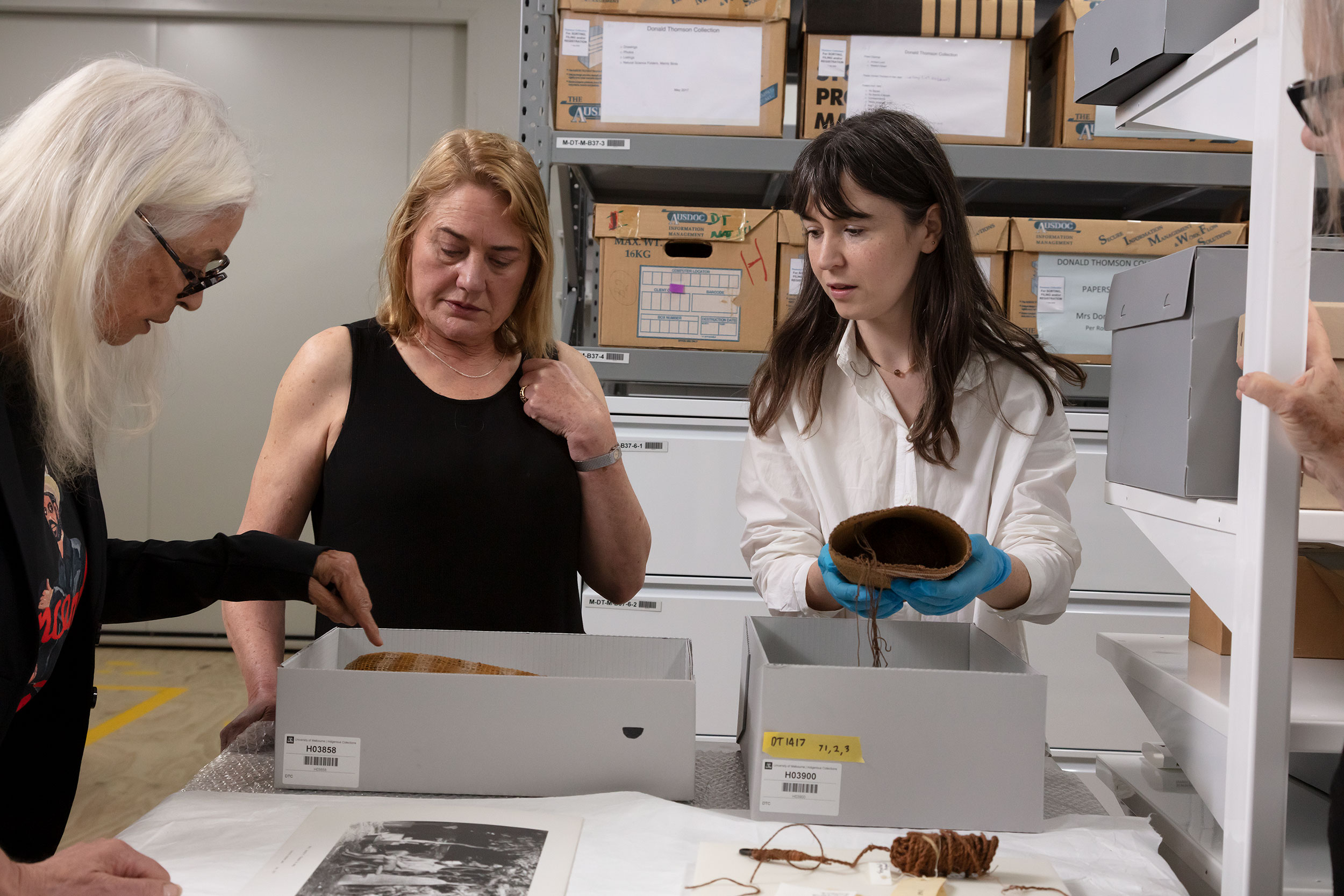
The University intends to build a Place for Indigenous Art and Culture on the Parkville campus to enable the collection to be appropriately cared for and to enable community access. The project will incorporate the Donald Thomson Collection Study Centre, facilities for research and study of the Donald Thomson Collection and the University’s digitised Indigenous Art and Culture collections.
Several artworks from the Collection will be displayed in the exhibition 65,000 Years: A Short History of Australian Art which opens at the University’s Potter Museum of Art on 30 May 2025 and run until 23 November 2025. The exhibition is curated by Professor Marcia Langton AO, Ms Judith Ryan AM and Ms Shanysa McConville in consultation with all relevant Indigenous people.
For those wanting to learn more about Donald Thomson's life and his work, Robert Macklin's biography The Donald Thomson Story: Fighting for Justice is now available.